
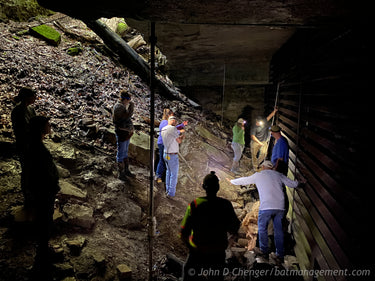


Level 2 Bat Capture & Handling Workshop (KY) September 1-5, 2026
 Level 2 Bat Capture & Handling Workshop (KY) September 1-5, 2026
$1,950.00
/
Level 2 Bat Capture & Handling Workshop (KY) September 1-5, 2026
$1,950.00
/

products.product.pickup_availability.unavailable
Step 1: Please checkout each person separately to secure seats. Students and self-funded BCM/BatSS alumni may qualify for discounted rate; consultants & all others are considered Standard Professional Registration. Email for more info.
Step 2: Each attendee -must- complete the Workshop Participant Pre-Survey this will help plan and steer special segments of the event.
Click here to complete the Workshop Participant Pre-Survey.
CLICK HERE to complete the Workshop Participant Pre-Survey
Each attendee should complete the pre-meeting survey. Select "Bat Physical Capture" and "KY". This will help steer special segments of the event. The participant list will be generated from this form. Special dietary needs should be listed here, but consider bringing your own snacks as we cannot accommodate all requests.
Meeting/Lecture Location: Mammoth Cave Lodge conference room (171 Hotel Road, Mammoth Cave, KY). This is an IN PERSON training.
Airport(s): The most convenient airport is Nashville International Airport (BNA), which is about 2 hours by vehicle and in Central Time zone (same as Cave City). Louisville International Airport (SDF) and Blue Grass Airport in Lexington (LEX) are 2-3 hours away respectively but are in Eastern Time zone.
Lodging: Lodging is not included in the cost of this training. There are cottages available onsite at the Mammoth Cave Lodge. Less expensive hotels are located nearby in Cave City and RV or tent camping is available at Diamond Caverns or Mammoth Cave National Park.
Meals: At least 3 lunches are provided during this workshop. Several restaurants are located at the Mammoth Cave Hotel. Cave City, while not far, is inconvenient. Coffee service will be available during daytimes.
This workshop is made possible with generous donations of time and resources from:
John & Lori Chenger, Bat Conservation and Management, Inc.
Keith Christenson, Tropical Bats


Students & self-funded BCM/BatSS Alum may qualify for discounted rates, contact us to apply. After reserving a spot in our workshop, each participant must complete the Workshop Participant Pre-Survey.
Bat Capture & Handling Workshop • Mammoth Cave, KY
- 5 nights of netting at stream, pond, cave, & forest settings September 1-5, 2026
- Hands-on net, & trap setup and teardown
- 1H, 2H, 3H type nets & various configurations for unusual situations
- Eastern bat ID & handling, measuring, and data management
- Demonstrating combining acoustic monitoring with physical captures
- This workshop is a long term monitoring project; 12 species physically captured in 2025 (11 in 2024, 9 in 2023); up to ~13 are possible
- Up to ~70 hours of contact time between lectures and field trips
- Level 2 class: participants should have some prior live animal handling experience
- Public "Bat Day" experience September 5; bring the family!
- Guest speaker Dr. Merlin Tuttle to speak on the importance of caves for bats, and leading a special cave visit.
Our course combines classroom discussions, hands-on demonstrations, and night-time field work designed to provide a solid foundation or great refresher in species identification, bat handling, netting, trapping techniques, and night vision observation.
Our workshop location is in the geologically world-class sinkhole plain of western Kentucky, which includes extraordinary Mammoth Cave National Park. At over 450 -miles- of surveyed passage, Mammoth Cave is without question the longest and most studied cave in the world. Our field work contributes to important ongoing long-term research and will acquaint us with a diversity of eastern bat species near caves and forest stream settings. This venue is especially valuable for instruction because of the diversity of local habitats providing roosts, foraging, watering, and hibernacula resources.
At this time of year we will have opportunity to witness the spectacular fall swarming behavior of gray myotis outside of a restored hibernacula. Experience culminates with participation in Mammoth Cave's family-friendly annual public Bat Day public program event for an extra epic field opportunity to handle bats in the entrance of the longest cave in the world.
Dates: Tuesday September 1 thru Saturday September 5, 2026. Training begins promptly at 9 AM central time and will end at midnight on Saturday night.
Scheduled Lecture and/or Demonstration Topics: Daytimes include in-person classroom lectures and live demonstrations. Note this workshop is not a tour and activities are planned up to 15 hours each day; please consider arriving a day(s) early or staying a day(s) later to visit the numerous tour options inside Mammoth Cave National Park and adjacent attractions. Our immersive workshop runs day and night; you will find little if any time to deal with "regular" work assignments. For in-depth training on bat acoustic monitoring, you may also be interested in our SonoBat Acoustic Monitoring Workshop
Capture Techniques: 1H Mist Nets, 2H Mist Nets, and 3H Mist Nets, Harp Traps and Other Methods
Morphological Identification of Eastern U.S. Bat Species
Micrositing, setting, demobilizing, maintaining, and WNS decon
Monitoring Bats Using Video, Night-Vision and Thermal Cameras
Bat Acoustic Hardware and Software: We offer another workshop in the same location specifically for bat acoustic monitoring. Students are welcome to bring or their own or borrow BCM bat detectors as desired, but no formal instruction is on the agenda. Participants will be given a full working trial of the SonoBatLIVE software to use.
USFWS Letters of Recommendation (LOR): Those seeking LOR should be aware that FWS recommendation letters are intended to cover -all- aspects of bat survey fieldwork that only comes from field experience of hundreds of nights at various sites and project types far beyond what can be accomplished in 5 nights. BCM is happy to provide letters of completion upon request, and we have methods to track who handled what animal correctly. However, instructors usually cannot provide recommendations after this event.
Pre-course Preparation: Those wishing to handle bats should already have taken a BCM Cat Capture & Handling course, or be comfortable handling other live small mammals or birds. Participants should be prepared to hike over uneven terrain at night, carrying personal gear and up to 50-pounds of field gear. Students must bring personal field gear including headlamps, appropriate clothing, bat handling gloves, and footwear for working outdoors, and basic personal items. Insect repellent for chiggers, ticks, and mosquitos is strongly advised, and poison ivy is present. Some sites require working in knee-deep water, in thick mud; waders or other appropriate footwear is highly recommended. There are opportunities for optional small group "remote" capture locations, where additional personal hiking gear and smartphone route tracking is strongly suggested. All survey equipment for capturing bats is provided.
Approximately 2-weeks prior to the start of class, students will receive a complete list of what to bring and how to prepare for class, but feel free to contact us at any time if you have specific questions about the class or how to prepare.
Prior bat-work experience is strongly recommended. Students wishing to handle bats should have some prior animal handling experience and must have obtained the rabies pre-exposure vaccination. The vaccine is at least two doses over several weeks that must be started at least two-months prior to class. Those already vaccinated can provide acceptable titre results or proof of recent booster. Those not vaccinated for rabies will not be permitted to handle bats, but may still take the course and gain bat ID experience.
How to Register: Please register by ordering online on this page. NOTE: ONE REGISTRATION per order; please use the "ship to" fields for the actual participant contact info, or the participant may not receive any information. Discounts do not apply to consulting agencies. Registration is not refundable after August 1, but is transferable.
All participants are expected to have personal insurance coverage and are expected to sign a liability waiver and photo release at the start of the workshop.
Scheduled in-person Instructors:
John Chenger learned how to survey bats while at the PA Game Commission for ~10 years. He then formed BCM in 1998 to further evolve bat surveys, artificial bat roosts, capture gear, and training classes nationwide.
Lori Chenger attempts to keep everyone on some kind of schedule, has real-world survey experience in at least 6 states and is recognized bat surveyor in PA.
Keith Christenson spent many years abroad studying bats and is a retired lead biologist from Sanders Environmental, a top bat capture consultant in the NE.
Amanda Miller participates in mist net, harp trap, bridge, and culvert surveys throughout the SE US while being a USFWS permitted bat biologist.
David Riggs is a Cave Resource Specialist, bat acoustic expert, and bat bridge inspector who has assisted with BCM special projects for a decade.
Andrea Rygel is a BCM biologist specializing in bat acoustics, mist netting, and radio telemetry projects across the Eastern US, and a qualified bat surveyor in PA.
Merlin Tuttle started his bat career as a teenager and has been a key force in changing the way the world perceives bats. He has studied and photographed hundreds of species of bats on every continent where they live. He founded and led Bat Conservation International for nearly 30 years, left in 2009, and founded Merlin Tuttle’s Bat Conservation in 2014, with his wife, Paula Tuttle. Merlin is comfortable crawling deep into caves, lugging equipment through tropical jungles, or standing on a stage introducing the world to the Secret Lives of Bats.
Todd Sinander is a federally permitted Environmental Review Project Manager with BCM since 2010. Ask him anything about bat mist netting, radio telemetry, or acoustic monitoring.
Joe Szewczak is a Professor of Biological Sciences at Cal Poly Humboldt in Arcata, CA, and the developer of SonoBat software to analyze and interpret bat echolocation calls.
What participants are saying . . .
These are some comments received after one of our Kentucky Bat Capture and Handling events:
“I really liked the adventure teams; mist netting in smaller groups enhanced the overall experience"
"Being able to have hands on experience handling bats will help me gain more experience opportunities in the future helping permitted folk so that I can eventually get enough experience to get my federal permit"
"Learning how to ID and handle Eastern bats was extremely helpful for my career development and growth!"
"This training far exceeded my expectations including all the material covered during lectures and materials received after the training."
"I learned things that I didn't know I needed to know!"
"Honestly, getting the hands-on bat experience with some of the more uncommon species was an unexpected plus from this training!"
Upcoming Events
Other events and workshops by Bat Conservation and Management


%20September%201-5,%202026)


