
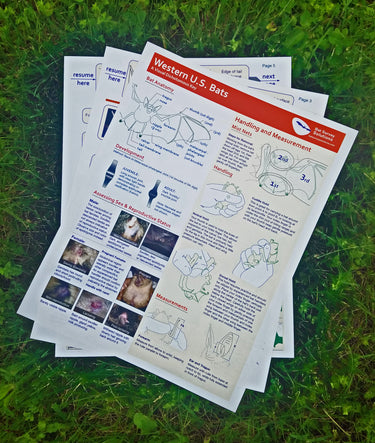


Western U.S. Bats ID Key
 Western U.S. Bats ID Key
$14.99
/
Western U.S. Bats ID Key
$14.99
/

products.product.pickup_availability.unavailable
Your payment information is processed securely. We do not store credit card details nor have access to your credit card information.

Waterproof. Tear-proof. Heat and Chemical-resistant.
A field-ready, visual guide for US Western Bats by Bat Survey Solutions.
We sought out to simplify the process of in-hand bat identification by creating a dichotomous key that was not only intuitive, but also visually engaging. Whether you’re new to bats, or a seasoned bat biologist, we’ve incorporated aspects of several traditional bat identification guides with updated, high-quality photos and illustrations to provide a “flow-chart-style” key, making it easier than ever to assess and compare the morphology of the bat in hand, with the bat on paper.
Complete with range-maps, information on the impacts of White-nose Syndrome, and illustrated tips on how to effectively remove bats from a mist net, the US Western Bat Key is an essential tool in any bat worker’s repertoire.
Key Features:
- Made with waterproof/rip-proof TerraSlate Paper
- Identify age, sex, and species of 33 bats of the Western US
- Detailed range maps
- Bat Anatomy reference diagram
- Step-by step net extraction instructions
- Easily sterilized during WNS decontamination
Ideal For:
- Portable reference guide
- Clipboard companion
- Education and training
- Live demonstrations
- Interpretive programs and workshops
The United States contains 47 species of bats, some with ranges from Hawaii to the northernmost point in Maine. The 33 species listed in this guide are those that can be found in the western half of the contiguous U.S.
Delivered in 3, double-sided unbound pages.
Questions & Answers
Have a Question?
-
Hello! I'm curious when it comes to distinguishing M. ciliolabrum vs M. californicus, is muzzle length referring to the base of the muzzle to the tip? Or is it the width of the muzzle across? I've seen other western bat keys that use the latter to distinguish the two species. Thank you! Taylor
MYCI and MYCA are very difficult to positively distinguish even in hand. The muzzles are a little subjective, especially if you don't have both bats side-by-side. In SE AZ I find the tail tip to be relatively easy and reliable: if the tip is 2mm past the tail membrane, it's MYCI. If the membrane just ends in the tip, then MYCA. If you happen to have a good bat acoustic microphone setup handy such as SonoBatLIVE+ Pettersson M500-384, then as a double check try to get a good recording preferably 5-10 seconds after releasing the bat. MYCA generally has a Fc of ~50kHz where MYCI will be distinctly lower at ~35-45 kHz. You actually could see this with a simpler detector such as a Batscanner. I recommend the Bat Survey Solutions AZ field workshop where you'd catch dozens of both: https://batsurveysolutions.com/collections/frontpage